Demand for reliable surface protection is expanding across mining, cement, steel, and heavy equipment maintenance. Grand View Research estimates that the global welding equipment market reached approximately USD 15.5 billion in 2023, with continued growth expected through 2030. Hardfacing materials support this expansion by extending component life under abrasion, impact, and heat.
A Hard Facing Welding Wire Drawing Machine converts alloy rod into accurately sized welding wire. Its performance depends on die quality, capstan stability, lubrication, cooling, and take-up control. Small errors matter. A slight diameter variation can disturb feeding speed, arc stability, and deposited-metal consistency. Dr. John C. Lippold, a respected welding metallurgy specialist, has emphasized that “welding is a metallurgical process, not merely a mechanical operation.” That principle applies directly to wire production.
Industry analysis from MarketsandMarkets also identifies automation, process control, and higher-performance welding consumables as important market drivers. Modern drawing lines therefore require more than high speed. Operators need stable tension, measurable elongation, clean surfaces, and repeatable output. Carbide dies may improve dimensional control, but they still require inspection and timely replacement. This is where suppliers sometimes overpromise. Real factory conditions are less perfect.
A dependable supplier should provide test data, line-layout guidance, spare-part support, and commissioning experience. Buyers should verify wire diameter tolerance, maximum drawing force, motor efficiency, and compatibility with hardfacing alloys. The best machine is not always the fastest one. It is the one that consistently produces usable wire, shift after shift, with traceable quality records.
China Best Hard Facing Welding Wire Drawing Machine Supplier
A hard facing welding wire drawing machine reduces wire diameter through calibrated dies and controlled pulling force. It prepares welding wire for surface repair and wear-resistant applications. The process improves diameter consistency, surface smoothness, and feeding stability. In practice, operators monitor tension, die temperature, lubrication, and spool alignment during production. Small deviations can create scratches, uneven coating, or unstable welding performance. The machine’s purpose is not simply to make thinner wire. It also helps maintain repeatable mechanical properties and reliable downstream feeding.
A suitable system usually includes drawing blocks, dies, cooling units, take-up equipment, and basic measurement tools. Experienced technicians check wire samples at regular intervals, rather than trusting settings alone. Diameter gauges, visual inspection, and tensile testing can reveal problems early. However, perfect output is not guaranteed. Material variation, worn dies, and incorrect lubrication may still affect results. This is why process records and scheduled maintenance matter. A supplier should explain capacity, wire material compatibility, speed range, and safety controls clearly.
Tips: Keep dies clean. Check tension often. Replace worn tooling early. Record each adjustment. Do not ignore slight surface marks; they may indicate a larger process fault. A trial run with real wire is wiser than relying only on specifications.
China Best Hard Facing Welding Wire Drawing Machine Supplier
Key Machine Components and Their Functions
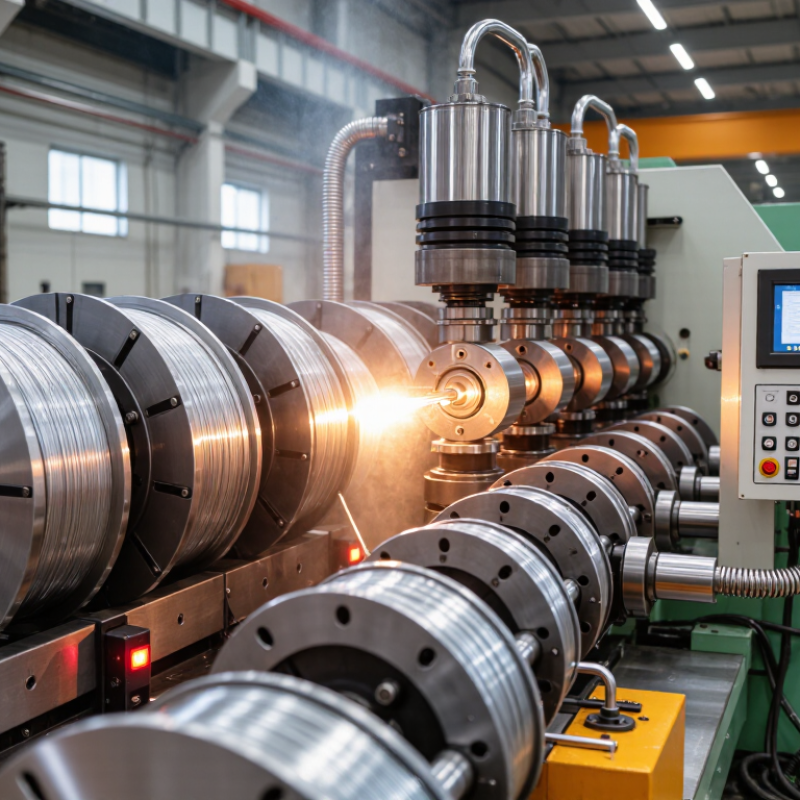
A hard facing welding wire drawing machine depends on coordinated components, not one impressive unit. The payoff stand releases the incoming wire steadily and prevents sudden tension changes. A descaling or cleaning section removes surface residue before drawing. This matters because small particles can damage dies and create unstable wire surfaces. Drawing dies reduce diameter through controlled deformation. Their material, angle, and cooling condition influence dimensional accuracy. The capstan pulls the wire through each die at a controlled speed. It must resist wear while maintaining consistent traction.
Tension sensors monitor the wire between drawing stages. They help prevent slack, stretching, and surface scratches. Cooling channels remove heat from dies and capstans during continuous operation. Excessive heat can shorten component life. The take-up unit winds finished wire evenly for later welding use. A level-wind mechanism prevents overlapping coils and tangled feeding. The electrical control cabinet coordinates speed, tension, alarms, and emergency stops. Practical operators still check these settings manually. Sensors can drift.
In production trials, I examine wire diameter, surface finish, winding density, and temperature records. A machine may run quietly yet produce uneven wire. That is easy to miss. Regular die inspection and lubrication checks improve repeatability. However, lubrication must match the wire material and process conditions. More lubricant is not always better. Careful commissioning, documented maintenance, and measured test results provide stronger evidence than appearance alone.
This engineering example shows the calculated wire-diameter reduction across seven drawing passes. Each pass applies an 18% cross-sectional area reduction, a commonly used design range for stable cold drawing. Drawing dies control the reduction, capstans provide synchronized traction, the lubrication system reduces friction and heat, and the take-up unit maintains consistent winding tension.
Wire drawing for hard facing welding wire begins with clean, correctly prepared wire rod. Surface preparation matters. Rust, scale, and oil can damage dies and weaken the final wire. The machine feeds the rod through a sequence of drawing dies, reducing its diameter gradually. Each pass must stay within a controlled reduction range. Excessive reduction creates heat, surface cracks, and unstable dimensions.
A practical drawing line uses strong capstans, accurate tension control, and continuous cooling. Drawing lubricant should spread evenly across the die entry point. Operators should monitor motor load, wire temperature, and surface appearance during production. A sudden load increase may indicate poor lubrication or a worn die. Carbide or diamond dies can support consistent sizing, but they still require scheduled inspection. Small scratches often become serious defects later.
After drawing, the wire passes through a calibrated take-up system. This prevents loose coils and protects the welding equipment during later use. Diameter checks should be made with reliable measuring tools at regular intervals. Tensile strength, straightness, and winding quality also deserve attention. In practice, not every batch behaves identically. Material hardness and coating condition can vary slightly. Operators sometimes tighten tension too quickly, believing it improves accuracy. It may do the opposite. Slower adjustment and recorded process data usually produce more dependable results.
China Best Hard Facing Welding Wire Drawing Machine Supplier: Quality Standards and Performance Evaluation
A reliable drawing machine should be judged by measurable output, not attractive brochures. ISO 14700:2022 provides a reference for hardfacing consumables, including deposited-metal quality and classification. The machine should maintain stable wire diameter, surface finish, and tensile consistency during continuous drawing. A practical factory check records diameter variation at several points per coil. For a 1.2 mm wire, a deviation below 0.02 mm supports steadier feeding and arc control.
Performance testing should include drawing speed, motor load, cooling temperature, and wire break frequency. Operators can inspect a 100-meter sample under fixed tension. They should also test deposition hardness, dilution, and wear resistance after welding. A 2022 ISO Survey reported more than 1.2 million ISO 9001 certificates worldwide. This figure shows the value of documented quality systems, but certification alone cannot prove machine performance. Factory acceptance data still matters.
Experience reveals small problems quickly. Uneven rollers may leave fine longitudinal marks. Excessive heat can soften the wire surface. These defects may appear minor, yet they can disturb automatic feeding. A supplier should provide calibration records, material traceability, and repeatability data from several production batches. No test is perfect. Humidity, operator skill, and alloy composition can change results. A stronger evaluation combines laboratory measurements with real welding trials, filmed at the customer’s actual line speed.
Selecting a reliable China-based supplier for a hard facing welding wire drawing machine requires more than comparing prices. A 2024 MarketsandMarkets report valued the global welding equipment market at over USD 16 billion, showing strong industrial demand. That growth also attracts inexperienced manufacturers. Ask for verifiable factory videos, equipment drawings, recent export references, and a live production test using your wire grade.
Technical evidence matters. Check the supported wire diameter range, drawing speed, die alignment, cooling method, payoff control, and take-up tension. Request measured results, not only catalog claims. A suitable supplier should provide factory acceptance testing, electrical documentation, spare-parts lists, and operator training. ISO 9001 certification can support process control, but it cannot replace inspection. Look closely.
Commercial reliability needs equal attention. The World Bank’s 2023 Logistics Performance Index shows that delivery predictability remains a major supply-chain concern worldwide. Confirm lead times, packaging details, payment milestones, installation support, and response times before signing. Ask how defects are recorded and corrected. A cheap machine may become expensive after one failed motor or poorly matched die. I would also compare total ownership cost, including energy use and maintenance intervals. No checklist is perfect. Remote inspections can miss small but important details, such as uneven welds, loose wiring, or excessive vibration. An independent pre-shipment inspection is often worth the extra cost.
It reduces wire diameter through calibrated dies and controlled pulling force. It improves surface smoothness, diameter consistency, and feeding stability.
A typical system includes drawing blocks, dies, cooling units, payoff equipment, and take-up equipment. Measurement tools are also important.
Operators should monitor tension, die temperature, lubrication, and spool alignment. Small changes can cause scratches or unstable wire feeding.
Technicians can use diameter gauges, visual inspections, and tensile tests. Regular sampling is safer than trusting machine settings alone.
Confirm the wire material, diameter range, drawing speed, cooling method, and take-up tension. Ask for measured production results.
Request factory videos, equipment drawings, export references, and a live test using your actual wire grade. A real trial reveals more.
Useful support includes acceptance testing, electrical documents, spare-parts lists, installation guidance, and operator training. Response times should be agreed clearly.
Energy use, die replacement, maintenance, failed motors, and installation delays affect total ownership cost. A cheaper machine may cost more later.
Remote checks may miss loose wiring, uneven welds, excessive vibration, or poor alignment. Independent pre-shipment inspection is often worthwhile.
Keep dies clean, check tension often, and replace worn tooling early. Record every adjustment. Do not ignore slight surface marks.
A Hard Facing Welding Wire Drawing Machine is designed to reduce and shape welding wire to precise diameters while improving surface quality, strength, and consistency. It typically includes a pay-off unit, drawing dies, capstans, cooling and lubrication systems, tension controls, and a take-up unit. Each component supports stable wire movement, reduces friction and heat, and helps maintain accurate dimensions throughout production. The drawing process usually involves cleaning, lubricating, repeated diameter reduction, cooling, and controlled rewinding.
To evaluate machine performance, manufacturers should consider dimensional accuracy, tensile strength, surface smoothness, production speed, energy efficiency, and operational stability. Quality standards, material compatibility, safety features, and ease of maintenance are also important. When selecting a reliable China-based supplier, buyers should review engineering capabilities, customization options, inspection procedures, after-sales support, delivery reliability, and overall communication. A suitable supplier should provide clear technical specifications and practical solutions that match the required hard facing welding wire production conditions.

Orient PengSheng