Flux Mixing Machine technology is becoming more important as manufacturers demand stable blends, shorter production cycles, and fewer material losses. Industry reports from MarketsandMarkets and Grand View Research identify automation, process consistency, and advanced industrial mixing systems as major market drivers. Their findings support a practical point: equipment selection now affects product quality, energy use, maintenance, and production risk.
Edward L. Paul, a respected industrial mixing specialist and co-author of Handbook of Industrial Mixing, wrote, “Mixing is the process of reducing or eliminating nonuniformities in a system.” That principle remains highly relevant to flux preparation. A suitable machine must handle powder, liquid binders, heat, and abrasive ingredients without creating dead zones. Small differences can matter. Uneven flux may cause inconsistent coating, poor flow, or rework.
This guide examines the Top 10 Flux Mixing Machine Manufacturers Worldwide. It compares engineering experience, mixing performance, automation options, material compatibility, service support, and documented customer applications. The ranking is not absolute. Regional standards, batch size, and formulation requirements can change the best choice. Some manufacturers publish limited technical data, which deserves careful review. Buyers should request test results, cleaning procedures, power requirements, and lifecycle costs before purchasing. A polished machine is not always the right machine. The real test appears inside the mixing vessel.
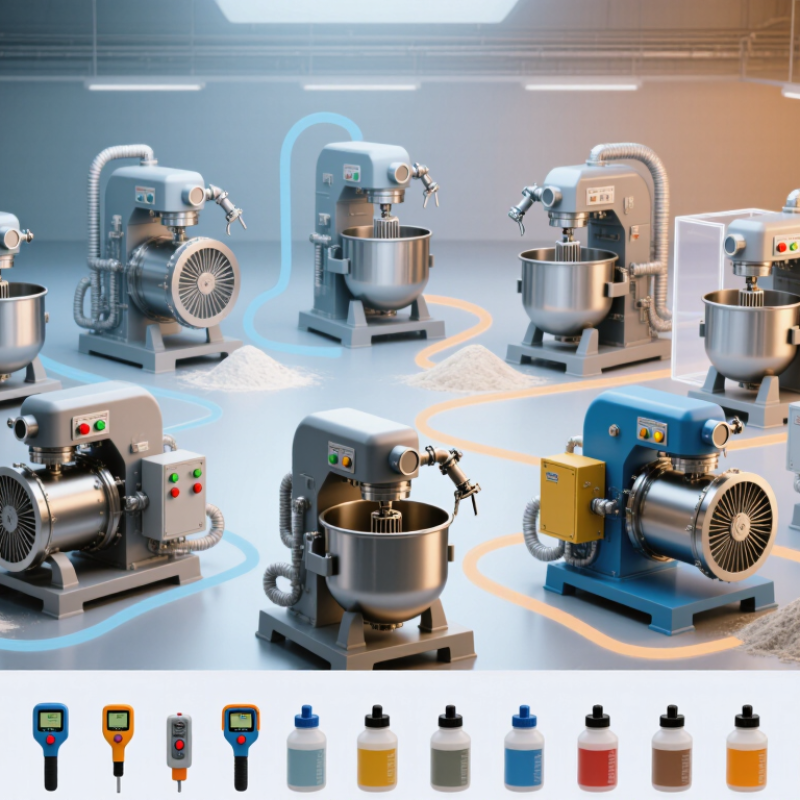
Flux Mixing Machines: Definition, Purpose, and Industrial Scope
Top 10 Flux Mixing Machine Manufacturers Worldwide
Flux Mixing Machines: Definition, Purpose, and Industrial Scope
Flux mixing machines combine powdered or liquid flux materials into a uniform working mixture. They control dispersion, moisture, viscosity, and temperature during processing. Common designs include ribbon mixers, planetary mixers, and vacuum-capable systems. Each design serves a different production challenge.
In electronics, metal treatment, and industrial joining, consistent flux quality affects wetting and bond performance. A mixer should prevent dry pockets, clumping, and excessive air capture. Operators often inspect the chamber after a trial batch. Small residues can reveal dead zones. That detail matters.
Industrial buyers should match machine capacity with batch size, material behavior, and cleaning requirements. High-viscosity compounds may need stronger torque and slower blade movement. Heat-sensitive formulas require controlled temperature and short mixing cycles. Vacuum mixing can reduce trapped air, but it adds maintenance demands. No machine fits every factory.
From my experience reviewing process layouts, equipment selection often focuses too heavily on motor power. That assumption can fail. Blade geometry, discharge design, sealing quality, and measurement accuracy also influence results. A reliable supplier should provide test data, service guidance, and realistic production limits. Buyers should request sample trials before approving a global installation.
Operating Principles and Core Components of Flux Mixing Machines
Flux mixing machines prepare soldering materials by combining rotation, orbital motion, and controlled pressure. In many systems, the sealed container spins around its own axis while orbiting a second axis. This centrifugal action blends flux without traditional blades. It can reduce air pockets and protect sensitive chemical fillers.
Core components include a drive motor, orbital bearing, mixing cup, balance sensor, lid lock, speed controller, and programmable timer. Some models add vacuum pumps, temperature probes, and load cells. A 2024 industrial mixer market analysis by Grand View Research projects annual growth of roughly 5% through 2030. That growth reflects stronger demand for repeatable material processing. IPC technical roadmaps also emphasize process stability as electronics become smaller and more densely assembled. However, speed alone does not guarantee uniform flux. That assumption is convenient, but not always correct.
Tips: Check viscosity before selecting a cycle. Keep the container balanced within the equipment specification. Record speed, time, temperature, and batch weight for every trial. ASTM D2196-based viscosity testing can reveal changes after mixing. Operators should inspect the cup and seal for residue, because small contamination may alter wetting performance. Vacuum mixing sounds ideal, yet excessive vacuum can change volatile content. The correct setting depends on formulation, container size, and temperature. I would not treat one successful batch as proof of a stable process. Trend data over several production runs is more reliable.
Criteria for Evaluating Global Flux Mixing Machine Manufacturers
When evaluating global flux mixing machine manufacturers, start with measurable process performance. A capable supplier should explain mixing uniformity, viscosity limits, particle suspension, and batch capacity clearly. Ask for test data using flux materials similar to yours. Generic demonstrations can mislead.
Inspect the machine’s construction in practical detail. Look for corrosion-resistant contact surfaces, stable temperature control, effective vacuum handling, and cleanable vessel geometry. The agitator should maintain consistent flow without creating excessive heat or air entrapment. Request records for calibration, factory testing, and safety compliance. Reliable manufacturers provide drawings, manuals, spare-parts lists, and documented maintenance intervals. Their engineers should discuss scale-up risks, not only machine specifications.
Service quality often separates a strong manufacturer from an average one. Evaluate installation support, operator training, response times, and local technical coverage. Ask how faults are diagnosed when production stops at night. References from similar industries are useful, but they are not perfect evidence. A polished test video proves little without independent measurements. I have seen buyers overvalue purchase price and overlook cleaning time, seal wear, and software limitations. That mistake can become expensive. No scorecard is perfect. Recheck assumptions with a small, witnessed trial before approving a global supplier.
Top 10 Flux Mixing Machine Manufacturers Worldwide
Criteria for Evaluating Global Flux Mixing Machine Manufacturers
This benchmark uses practical purchasing criteria commonly applied to industrial flux mixing equipment. The percentages represent an editorial evaluation framework, not the performance of any individual company or brand. Mixing uniformity, throughput, thermal control, air removal, and material handling receive the highest weighting because they directly influence process consistency and production efficiency.
Profiles of the Top 10 Flux Mixing Machine Manufacturers Worldwide
The ten leading flux mixing machine manufacturers reveal a market shaped by precision, repeatability, and service depth. Their profiles differ sharply. Some specialize in compact benchtop mixers, while others build automated systems for high-volume electronics plants. The strongest suppliers usually provide controlled temperature, programmable agitation, sealed containers, and traceable batch records. These features matter when flux viscosity changes during a production shift.
Market data supports this emphasis. The IPC Electronics Industry Sentiment report continues to identify supply-chain stability, quality control, and workforce capability as major manufacturing concerns. Meanwhile, MarketsandMarkets projects continued growth in the global soldering equipment sector through the decade, driven by miniaturized components and denser circuit assemblies. Within the ten profiles, manufacturers with strong process documentation appear better prepared for these demands. That is not always obvious from product brochures.
Look closely at engineering evidence. Reliable manufacturers publish mixing-speed ranges, container capacities, calibration procedures, and cleaning requirements. Several profiles also show regional service networks, spare-parts availability, and operator training. Those details can reduce material waste and unplanned downtime. ISO 9001 certification helps, but certification alone proves little about actual mixer performance. Buyers should request trial batches using their own flux formulation. A glossy specification sheet cannot reveal every practical weakness. Even experienced teams can overlook seal wear, solvent compatibility, or difficult tank cleaning. That limitation deserves more attention in future industry comparisons.
Conclusion
This article provides a practical overview of the global flux mixing machine industry, beginning with the definition, purpose, and industrial scope of these machines. A Flux Mixing Machine is designed to combine flux materials evenly and consistently, helping manufacturers improve process stability, material quality, and production efficiency. The article also explains the operating principles and core components, including mixing chambers, drive systems, feeding units, control panels, and discharge mechanisms.
It then outlines key criteria for evaluating manufacturers worldwide, such as engineering capability, material compatibility, customization options, automation, safety design, quality control, technical support, and after-sales service. The profiles of the top ten manufacturers are presented through general comparisons rather than brand promotion. Finally, the article discusses common applications, relevant industry standards, maintenance needs, and practical selection considerations, helping buyers choose equipment according to production scale, mixing requirements, operating environment, energy efficiency, and long-term reliability.
 Orient PengSheng
