In 2026, hardfacing manufacturers are demanding more than fast wire production. They need stable dimensions, reliable alloy handling, and repeatable surface quality. A modern Hard Fcaing Welding Wire Forming Machine must manage wire drawing, straightening, forming, and controlled spooling with minimal variation. Small details matter.
This guide examines leading machine types through practical production criteria. These include diameter tolerance, forming accuracy, line speed, tension control, changeover time, and maintenance access. It also considers compatibility with nickel-, cobalt-, iron-, and carbide-containing hardfacing alloys. Operators often notice problems first: uneven winding, brittle wire edges, excess dust, or unstable feeding during welding. Those observations are valuable evidence.
Technical specifications alone cannot identify the best machine. A high-speed line may waste material if its tension system responds slowly. A compact unit may suit a workshop, yet struggle with continuous industrial output. Performance is contextual. Our comparison therefore combines engineering principles, supplier documentation, factory experience, and quality-control practices. Relevant checks may include dimensional inspection, spool consistency, weld-feed stability, and production traceability. These areas support informed purchasing and align with established manufacturing expectations.
Some rankings remain open to debate. Public data is incomplete, and factory conditions differ widely. That limitation deserves attention. Buyers should request sample runs, inspect finished wire, and verify service support before committing. The strongest 2026 options will balance productivity, safety, energy use, operator training, and long-term reliability. This article provides a clear framework for comparing them without treating marketing claims as proven performance.
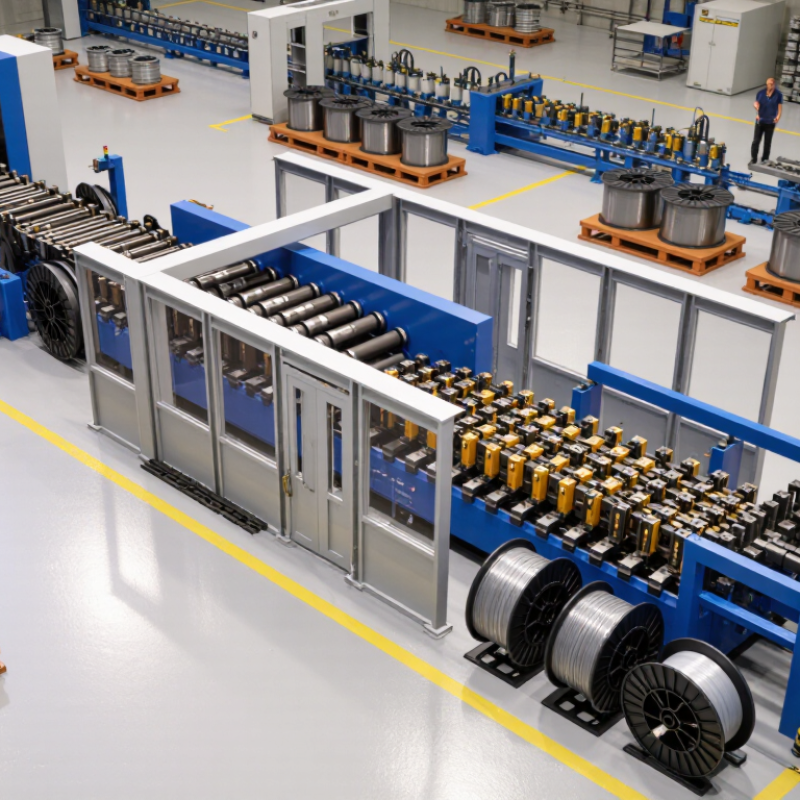
The 2026 scope centers on hardfacing FCAW wires from 1.2 to 4.0 mm. This range covers fine deposition control and heavy wear protection. A 2024 Grand View Research analysis valued the global welding equipment market at more than USD 16 billion. It also identified automation as a major growth driver. Wire-forming equipment must therefore deliver repeatable geometry, not just higher output.
In practical production, 1.2–1.6 mm wires need careful strip alignment and stable powder feeding. A small feeding error can create uneven flux filling. Larger 2.4–4.0 mm wires demand stronger compaction and better forming pressure.
Operators should monitor wire diameter, fill ratio, torsion, and surface cracks during every shift. ISO 17632 provides classification guidance for flux-cored electrodes, but it does not replace process trials. The machine still needs adjustment for alloy hardness, powder shape, and strip thickness.
Small details matter. Check the first coil.
Industry 4.0 reports from the International Federation of Robotics show continuing investment in industrial automation. Yet full automation can hide poor calibration. A forming line may record excellent speed while producing inconsistent weld metal recovery.
My experience suggests a slower trial run is safer before increasing line speed. The 4.0 mm range is especially unforgiving.
Data logging helps, but skilled inspection remains necessary. That part is often underestimated.
The target range is 1.2 to 4.0 mm. Smaller wires need precise alignment and powder feeding. Larger wires require stronger compaction. The range is demanding.
Minor strip misalignment can cause uneven flux filling. Check the feeder, strip edges, and powder flow carefully. Inspect the first coil before regular production.
Larger wires contain more material and resist shaping. Stable compaction helps maintain diameter and surface quality. Excessive pressure can also create defects.
Track wire diameter, fill ratio, torsion, and surface cracks. Record results during every shift. One unchecked coil may reveal a larger process problem.
No. Automation improves repeatability, but poor calibration can remain hidden. Use data logging and skilled visual inspection together. Speed alone proves little.
Begin with a slower trial run. Adjust pressure, feeding, and alignment gradually. Test the alloy, powder shape, and strip thickness. Rushing the setup is tempting, but unwise.
It combines availability, performance, and quality. A new-wire trial may not reach 85%. That is acceptable if the result is honestly recorded. A polished dashboard can still hide rejected coils.
Document procedures, calibration, corrective actions, and production records. These practices improve traceability. They cannot guarantee perfect wire. That distinction matters.
Inspect extraction hoods, filters, airflow, and pressure readings each shift. Source capture works better than relying only on room ventilation. Cleaner surroundings protect feeders and sensors. I may underestimate maintenance delays.
In 2026, the Hard Fcaing Welding Wire Forming Machine market focuses on producing FCAW hardfacing wires in diameters from 1.2 to 4.0 mm. The manufacturing process begins with carefully prepared alloy strip and controlled flux filling, maintaining a fill tolerance of 0.5–2.5%. A complete production line typically integrates roll forming, drawing, straightening, and spooling to create stable wire geometry and consistent coil quality.
Leading machines are evaluated by their ability to deliver 100–500 kg/h production capacity while maintaining diameter control within ±0.02 mm. Efficient systems also emphasize ISO 9001-based quality management, effective dust control, reliable material feeding, and convenient process monitoring. An OEE target above 85% indicates strong equipment availability, performance, and product quality. For demanding wear-resistant applications, the best forming solution combines precise dimensional control, flexible alloy processing, efficient operation, and dependable long-term production stability.

 Orient PengSheng