Engineered to deliver exceptional dimensional accuracy, high productivity, and complete integration with industrial automated processing lines.
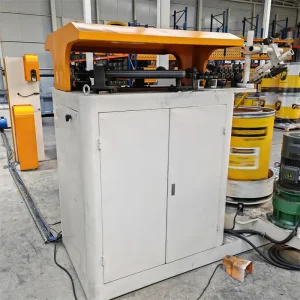
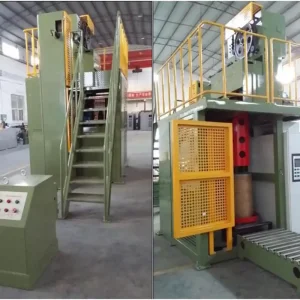
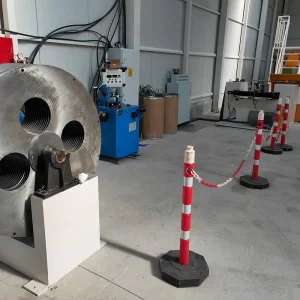
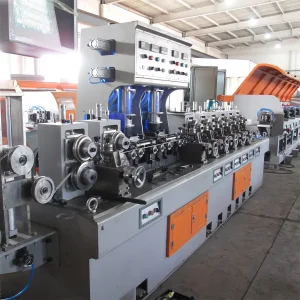
Why high-conductivity copper busbars require premium electro-tinning or hot-dip tinning surface treatments to survive high-stress electrical distributions.
A Copper Busbar Tin Coating Line is a specialized industrial system designed to continuously plate a thin, uniform layer of tin onto the surface of flat copper strips or profiles. Copper is highly valued for its superior electrical conductivity (100% IACS), but it is naturally susceptible to atmospheric oxidation. Once oxidized, a layer of copper oxide ($Cu_2O$/$CuO$) forms on the surface, increasing contact resistance dramatically and risking thermal runaway in high-amperage components.
Tin coating ($Sn$) offers an optimal balance of protection, low contact resistance, and affordability compared to silver or gold. By implementing a high-speed, continuous plating line, manufacturers ensure that copper busbars are protected against harsh environmental conditions, acidic atmospheres, and high-humidity installations.
Industrial busbar tinning is executed via two primary methodologies. Choosing the correct line type is critical for matching end-product specifications:
| Parameters | Electro-Tin Plating | Hot-Dip Tin Plating |
|---|---|---|
| Thickness Control | Ultra-precise (1µm to 20µm) | Varying (8µm to 50µm) |
| Intermetallic Compound (IMC) | Thin, develops over time | Thick, formed immediately |
| Surface Finish | Bright or Matte, highly smooth | Rougher, shiny metallic grey |
| Thermal Stress | No thermal deformation | Potential annealing effects |
How state-of-the-art continuous roll-to-roll (or cut-to-length) electro-tinning lines achieve micro-level uniformity across high-volume production batches.
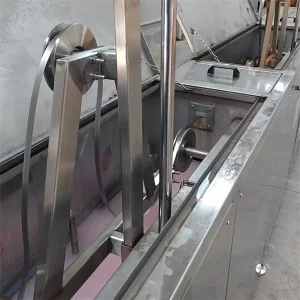
Successful electro-deposition requires absolute removal of surface organic films and oxides. The line utilizes integrated ultrasonic cleaning stages, electro-degreasing utilizing hot alkaline baths, and acid pickling (usually diluted $H_2SO_4$ or MSA) to active the copper crystal lattice for maximum adhesion.
Using advanced Methanesulfonic Acid (MSA) electrochemistry, the busbar runs through multiple plating chambers. Advanced rectifiers apply high current densities, depositing pure tin at molecular levels. Automated electrolyte dosing systems continuously balance $Sn^{2+}$ ions and acid concentrations.
To prevent tin whisker growth and structural yellowing, the tin layer undergoes neutral rinsing, proprietary chemical passivation, and hot-air drying. Some high-end lines incorporate induction-reflow heaters that melt the outer tin layer temporarily to seal microscopic voids.
Understanding what global OEMs, electrical switchgear manufacturers, and EV battery pack builders demand from modern busbar surface coating processes.
The explosion of Electric Vehicle (EV) battery systems, charging stations, and grid-scale energy storage has transformed the copper busbar industry. Electric vehicles require busbars that can reliably handle voltages up to 800V or 1000V. At these power levels, any defect in the tin layer can lead to high resistance points, localized heating, and potential insulation breakdown.
Procurement managers are no longer just buying "tinned copper." They require guaranteed specifications: minimum tin purity (>99.9%), exact control over intermetallic compound layer thickness ($Cu_6Sn_5$), and compliance with rigorous international automotive standards such as ISO 2093 or ASTM B545.
Traditional electroplating lines utilized lead-bearing stabilizers or fluoroboric acids which represent immense ecological hazards. Global procurement guidelines mandate zero-waste, environmentally friendly operations. Modern tin coating lines must be designed with closed-loop wastewater recovery, fume extraction systems, and zero lead usage. Heavy filtration systems remove copper contaminants, allowing manufacturers to recycle up to 98% of process chemicals.
Established in 2011, Beijing Orient Pengsheng Tech. Co., Ltd. has amassed over 20 years of intensive experience in high-performance metal wire and strip processing technology. Supported by European technical cooperators and continuous proprietary innovations, we have established our own technology, know-how, and world-class manufacturing facilities in the industry.
Our mechanical expertise extends from advanced steel strip slitting lines and high-accuracy forming machinery to industrial ultrasonic cleaning systems and plating line components. Having delivered over 150 production lines to 10+ countries, including highly demanding markets in Western Europe and the United States, we represent a trustworthy partner for complex industrial machine integrations.
By manufacturing in China, Orient Pengsheng provides clients with unbeatable lead times and structural cost efficiencies. The vast Chinese industrial base guarantees rapid procurement of premium structural components, integrated electrical hardware, and raw materials. Our clients benefit from lower CAPEX requirements without compromising on machine engineering tolerances or components longevity.
Where reliability under critical current loads is non-negotiable. Modern tinning lines ensure component durability across these key sectors:
Modern electric vehicles rely on flat, tin-coated copper busbars to link cells inside battery modules. Plating thickness consistency is crucial to ensure clean welding and bolting. The high-precision coating resists moisture ingress and vibrational wear over the vehicle's lifespan.
Power grid distribution panels operate 24/7/365 under constant high voltages. Corrosion on contact surfaces can lead to power grid instability. Our tin plating lines apply durable, thick matte tin finishes that resist oxidation even in outdoor marine environments.
Renewable energy generation involves wide fluctuations in temperature and environmental conditions. Tinned copper profiles ensure seamless mechanical coupling, preventing thermal cyclic loosening at interfaces between copper busbars and electrical panels.
How we bridge manufacturing in China with strict Western quality regulations to offer a seamless cross-border implementation.
Every machine that leaves Orient Pengsheng facilities is built to meet CE directives, mechanical safety codes, and local electrical regulations (such as UL in North America or VDE in Germany). We supply complete documentation packages to simplify plant integration: certificate of origin, chemical safety compliance sheets, electrical drawings, and structural certifications.
To ensure smooth machinery installation and quick production startup, Orient Pengsheng maintains a highly-educated team of field engineers. We offer pre-sales quotation and engineering consultation, on-site mechanical alignment, electrical commissioning, and complete operator training. We can also dispatch technical experts for scheduled maintenance, tooling replacements, and chemical bath calibration troubleshooting.
Find answers to technical specifications, pricing structures, shipping standards, and post-installation support.
Discover our adjacent metal-forming, steel slitting, precision wire drawing, and packaging machineries.
Let us configure the perfect metal strip cleaning, processing, or wire drawing system for your specific plant footprint.
If you are interested in any of our technical solutions or have inquiries regarding custom electroplating line parameters, feel free to send us an email. Our technical division will respond with detailed proposals and engineering layouts.
Submit Technical Inquiry Orient PengSheng