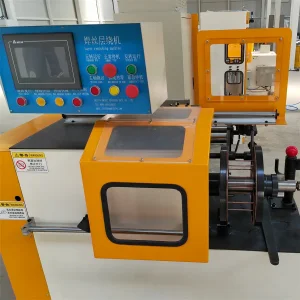
In modern industrial welding, flux-cored arc welding (FCAW) is the preferred method for structural steel fabrication, heavy construction, shipbuilding, and offshore platforms due to its high deposition rates, excellent weld pool control, and versatility in out-of-position applications. Among various classifications, the E71T-1 carbon steel flux-cored wire is highly valued for its rutile-based slag system, which provides a smooth arc, low spatter levels, easy slag removal, and outstanding mechanical properties.
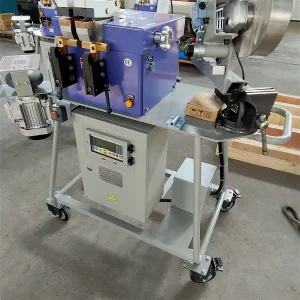
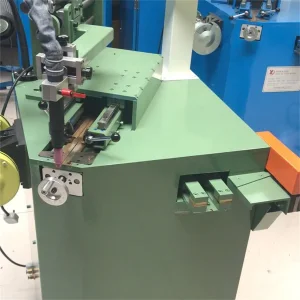
The quality and consistency of E71T-1 flux-cored wire depend on the precision of its raw materials, flux formulation, and manufacturing machinery. The heart of the production process is the Overlap Welding Wire Forming Unit. This machine continuously shapes a flat, low-carbon steel strip into a U-profile, fills it with a highly calibrated recipe of flux powders, and then folds the strip edges to create a tight mechanical "overlap" seam. Unlike seamless cored wires produced via tube filling and drawing, the mechanical overlap method allows for incredibly high production rates, flexible chemical recipe changes, and optimal control over the powder-to-strip filling ratio.
A high-efficiency E71T-1 overlap forming unit comprises several synchronized electromechanical modules designed to manage dynamic stress distribution on the steel strip. The engineering process requires deep material physics, precision alignment, and real-time electronic feedback loop control.
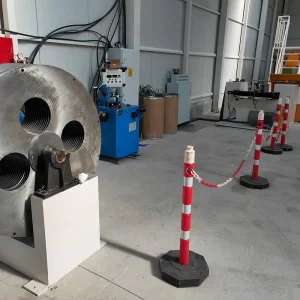
Ensures continuous, twist-free payout of the steel strip (typically SPCC or low-carbon steel, width 12mm–16mm, thickness 0.6mm–0.8mm) under tension control. Closed-loop load cells monitor tension fluctuations, preventing strip elongation or misalignment before entry into the forming rollers.
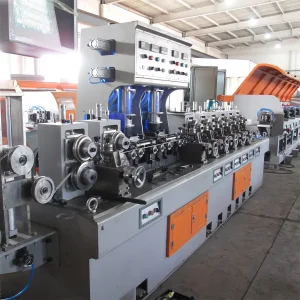
Using a series of precision-ground tungsten carbide roller passes, the flat strip is gradually shaped into U-profile, then O-profile. Each pass is engineered using finite element analysis (FEA) to minimize edge stretch, internal stress concentration, and surface micro-cracking.
A high-accuracy micro-metering device drops the E71T-1 flux powder formula into the center of the U-channel. Equipped with ultrasonic vibratory feeders and optical level sensors, the system maintains a filling ratio precision of ±0.2% by weight, preventing hollow spots or overfilling.
After the powder is deposited, the U-profile enters the closing stage. Special horizontal and vertical rolls guide one edge over the other, creating a mechanical lock (the overlap seam). The wire is then pre-reduced through rolling cassettes to compress the inner powder, achieving a solid density profile that behaves like a solid wire during wire drawing.
Established in 2011, Beijing Orient Pengsheng Tech. Co., Ltd. has grown to become a global leader in designing, manufacturing, and supporting high-capacity flux-cored welding wire production machinery. With over 20 years of hands-on experience, our engineers combine mechanical design with the latest electronics to offer complete turnkey plants.
With the technical support of our European partners and our own continuous innovation, we have developed proprietary technologies, manufacturing processes, and quality control systems in the wire-forming sector. We specialize in supplying machinery that complies with international standards, helping manufacturers worldwide achieve stable, high-yield, and defect-free production.
Deep know-how in mechanical design, tooling wear resistance, and flux chemical dynamics.
Proven machines operating globally, complying with European and American quality standards.
Key manufacturing equipment and electronic controls are imported directly from Europe.
Pre-sales consultation, on-site installation, and operator training worldwide.
Our core manufacturing processes utilize advanced European equipment, ensuring that all components of the forming unit—such as gears, drives, and roll housings—meet strict dimensional tolerances. This results in stable production and minimal machinery vibration.
We continuously refine our machinery based on feedback from operating plants. By monitoring real-world wear rates on rolling cassettes and forming rollers under continuous operation, we make design improvements to maximize uptime.
We maintain long-term partnerships with our clients, adapting production lines to accommodate new flux formulations, changes in strip thickness, or target wire specifications. This collaborative approach helps optimize manufacturing processes over time.
Beijing Orient Pengsheng provides complete, end-to-end production lines to manufacture flux-cored welding wires that comply with international standards (such as AWS, ISO, and EN). The process involves several key technological steps:
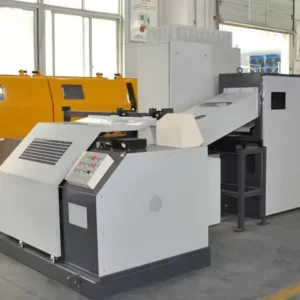
The process begins with wide coils of low-carbon steel strip, which are slit into precision-width strips (up to 15 cuts simultaneously). This slitting stage ensures clean, burr-free edges, which are essential for forming a uniform, leak-proof overlap seam.
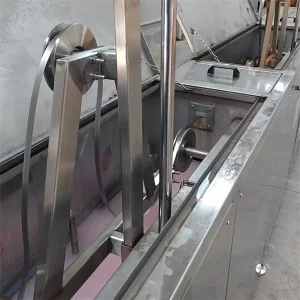
Residual oils, grease, and rust on the strip surface must be completely removed to prevent hydrogen contamination in the final weld. Our ultrasonic cleaning lines utilize multi-stage solvent tanks to wash the strip before forming.
The clean steel strip is progressively shaped into a U-profile, filled with the flux powder mixture via a gravimetric metering system, closed into an O-profile with an overlapped seam, and then pre-drawn to lock the core powder in place.
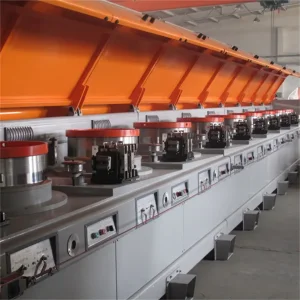
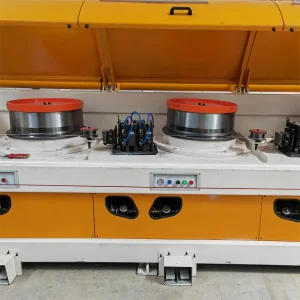
The formed wire (approx. 5.5mm diameter) is drawn through a series of straight-line drawing blocks using tungsten carbide dies or rolling cassettes. This stage reduces the wire to final sizes (e.g., 1.2mm, 1.4mm, or 1.6mm) without putting torsional stress on the mechanical overlap seam.
The finished wire is wound onto plastic or wire spools using a high-precision layer winding system. Accurate pitch control prevents tangling during robotic or semi-automatic welding processes.
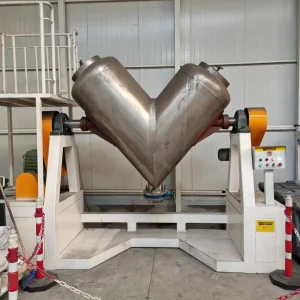
Consistency in the chemical composition of the flux (which includes rutile, ferro-alloys, deoxidizers, and slag formers) is essential. Our powder mixing, heating oven, and mesh vibration machines help ensure uniform particle size and dry ingredients.
Welding wire manufacturing is heavily influenced by local market requirements, structural steel standards, and labor availability. Here is how E71T-1 overlap flux-cored wires produced on our forming lines are deployed in different global markets:
In European and Asian shipyards, E71T-1 cored wire is used for fillet welding of stiffeners, structural hulls, and bulkheads. The wire must have consistent drawing characteristics and uniform flux distribution to prevent wormholes and porosity during multi-pass welding. Our overlap forming units provide the necessary filling consistency to meet classification society certifications (such as ABS, DNV, and LR).
North American and Middle Eastern construction projects require structural welds that can withstand seismic and dynamic loads. E71T-1 wire provides the deposition rate and penetration characteristics needed for these heavy-duty welds. Our forming line's precision powder metering ensures that deoxidizers like silicon and manganese are distributed evenly along the length of the wire.
Heavy machinery manufacturers utilize robotic welding stations that operate at high wire feed speeds (up to 15 m/min). If the wire has variations in diameter or internal powder distribution, it can cause arc instability or contact tip wear. Our drawing cassettes and tension controls help produce wire with consistent dimensions and stiffness.
The flux-cored wire manufacturing industry is moving toward greater automation, process monitoring, and energy efficiency. Orient Pengsheng is actively developing and integrating new technologies to support this transition:
Future iterations of our overlap forming units will incorporate inline eddy-current testing and laser measurement systems. These sensors check the integrity of the overlap seam and measure wire diameter in real-time, allowing operators to make adjustments before defects occur.
We are designing our control systems to integrate with factory MES (Manufacturing Execution Systems). This allows plant managers to monitor powder consumption, forming speeds, motor load, and energy usage in real-time from a central dashboard.
By utilizing high-efficiency permanent magnet motors and common DC bus drive configurations, our newer drawing and forming lines help reduce energy consumption by up to 15% under continuous operation.
Beijing Orient Pengsheng utilizes China’s industrial ecosystem to deliver reliable, high-performance machinery. Our supply chain configuration offers key advantages for our global partners:
Our proximity to high-grade steel producers and specialized component manufacturers in North China allows us to source raw materials, custom castings, and precision motors with short lead times. This enables us to maintain efficient production schedules.
The regional concentration of machining centers, heat treatment facilities, and electronics suppliers allows us to quickly source replacement parts and custom tooling. This supports efficient engineering development and shortens delivery times.
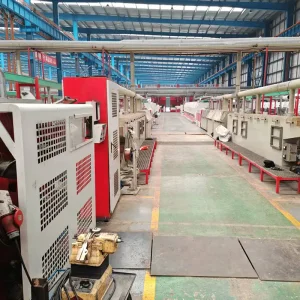
Our manufacturing facility in Beijing has dedicated testing bays where we assemble, align, and dry-test complete production lines before shipping. Customers can review operational parameters and perform pre-acceptance checks prior to dispatch.
Deploying high-speed machinery in global locations requires strict adherence to safety standards, electrical codes, and regulatory frameworks. We design and build our machinery to meet these local requirements:
Our machinery is engineered to comply with European safety standards, including CE certification, low-voltage directives, and machinery directives. The wiring layouts, safety interlocks, and enclosure guards are designed to meet OSHA and European occupational safety regulations.
Our service department employs qualified technicians who can travel to client sites to manage unloading, mechanical leveling, alignment, and final calibration. We provide training for operators on mechanical adjustments, tooling changes, and routine maintenance.
Our electrical control cabinets can be configured with secure VPN access modules. This allows our software engineers to troubleshoot PLC programs, diagnose drive faults, and update operating parameters remotely, helping to resolve issues quickly.
The overlap method folds a flat steel strip around a core of flux powder, creating a tight mechanical joint. It allows for high production speeds, quick powder recipe changes, and lower overall setup costs. The seamless method starts with a welded tube that is filled with powder and drawn down, which requires specialized filling and baking equipment to control moisture but eliminates the seam entirely. Both methods are widely used, but the overlap process is the global standard for high-volume E71T-1 production.
The unit uses a high-precision, closed-loop vibratory feed system. Powder flow rate is continuously adjusted based on the line speed of the forming mill. Optical sensors in the powder hopper monitor fill levels, and ultrasonic vibrators maintain constant density in the feed tube, keeping the filling ratio within a tolerance of ±0.2%.
To handle the wear associated with continuously folding steel strip, our forming rollers are machined from high-grade tool steel (such as Cr12MoV or H13) and heat-treated, or manufactured with tungsten carbide inserts for high-wear areas. Drawing cassettes use tungsten carbide rollers to ensure long service life and dimensional stability under drawing loads.
We provide a 12-month warranty from the date of machine startup. The warranty covers manufacturing defects and structural failures but excludes normal wear and tear on consumable parts (such as rollers, dies, and belts). We offer commissioning support, operator training, and keep a stock of standard spare parts to minimize downtime.
Our standard payment terms are a 30% deposit by T/T, with the remaining 70% balance paid by irrevocable L/C at sight or T/T against shipping documents. Delivery time typically ranges between 2 to 3 months, depending on the level of customization and the current production schedule at our facility.
We prepare all machinery for ocean transport. Surfaces are coated with rust-inhibiting oils, wrapped in heavy-duty plastic vapor barriers, and secured inside wooden crates or steel frames. All structural frames are bolted and braced inside containers to prevent movement during transit.
For inquiries regarding custom machinery configurations, system integration, or layout design, please contact our engineering and sales department.
Submit your production requirements and our technical team will respond to you within 24 hours.
Email Technical Support Orient PengSheng