Deploying world-class automation and material processing machinery to secure structural reliability and chemical homogeneity in flux cored welding wires.
For over two decades, Beijing Orient Pengsheng Tech. Co., Ltd. has worked at the frontier of welding technology. Established in 2011, we integrate European design concepts with high-precision manufacturing systems. By specializing in complete Flux Cored Wire (FCW) production plants, we empower manufacturers globally to achieve seamless, high-yield metallurgical operations.
The production of high-performance flux-cored wire (FCW) is heavily dependent on the quality and homogeneity of the flux powder mix. The chemistry of the core powder determines arc stability, slag coverage, weld pool fluidity, deposition efficiency, and mechanical integrity under extreme loads.
Through rigorous research, design cooperation with leading European engineering groups, and ongoing validation across international markets, Beijing Orient Pengsheng Tech Co., Ltd. has developed advanced proprietary solutions for powder mixing, baking, and dosing.
Understanding why raw material preparation determines the ultimate quality of the flux-cored welding wire.
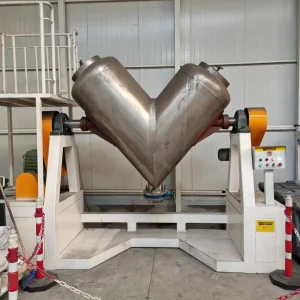
Flux powder is composed of raw materials with vastly different specific gravities (e.g., heavy iron powder, metallic alloys, rutile, fluorides, and silica). Our advanced mixers implement high-shear three-dimensional blending kinematics to prevent gravimetric settling and ensure distribution homogeneity down to parts-per-million limits.
Diffusible hydrogen poses the greatest threat to high-yield structural welds. Any residual moisture in the flux powder leads directly to cold cracking (hydrogen-induced cracking). We integrate critical powder heating ovens into our systems to control moisture levels below strict threshold requirements prior to filling.
Mechanical crushing of fragile powder aggregates during mixing must be avoided. A precise Froude number configuration ensures that blending action is achieved via low-impact convection rather than compressive shear, keeping the primary particle distribution curve constant.
An engineering comparison highlighting why dedicated flux powder mixing machines outperform standard vertical/ribbon mixers.
| Performance Parameter | OPS Premium Flux Powder Mixers | Standard Ribbon Mixers | Standard Vertical Mixers |
|---|---|---|---|
| Homogeneity Level | ≥ 99.8% (Highly Homogeneous) | ≥ 92.5% (High risk of segregation) | ≥ 88.0% (Poor density distribution) |
| Cycle Time (Batch) | 6 - 15 Minutes | 30 - 45 Minutes | 40 - 60 Minutes |
| Material Density Range | 0.5 g/cm³ - 7.8 g/cm³ | Max 3.0 g/cm³ | Max 2.0 g/cm³ |
| Baking & Moisture Integration | Fully integrated heating option | External only / Non-uniform | Not applicable |
| Abrasive Wear Protection | Replaceable wear liners (Hardox/Ceramic) | Standard stainless steel plate | No internal protective lining |
Navigating regional standards, carbon reduction targets, and digital traceability requirements in the international procurement of welding equipment.
OEMs in Western Europe and North America require reliable mechanical and electrical components. By utilizing standard components sourced from Europe, Beijing Orient Pengsheng ensures long-term operational uptime and fast spare parts procurement.
Modern steel wire drawing and powder processing machinery must reduce energy consumption. Our integrated control loops limit peak electrical draw during high-speed drawing and heat-intensive baking stages.
Traceability of chemical raw materials is essential for high-performance welding applications (e.g., offshore oil and gas or nuclear construction). Our automated control systems log and store exact powder weights, temperatures, and cycle parameters.
Every factory operates with unique space constraints and wire diameter ranges. We tailor individual drawing machine line layouts, slitting numbers, and powder feed rates to optimize performance in your facility.
How powder preparation works in tandem with downstream machinery to form a high-yield production line.
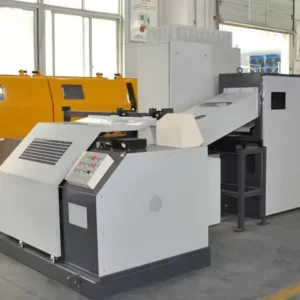
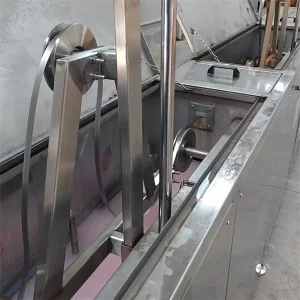
Low-carbon steel strips are cut using our high-precision Steel Strip Slitting Line. The strips then pass through our Ultrasonic Cleaning Machine to remove residual oil, rust, and surface contaminants, ensuring a clean bonding surface.
The Flux Powder Mixing Machine mixes raw metallic and non-metallic powders. It is then transferred to the heating oven and vibration mesh units to guarantee dry, clinker-free powder with the correct particle distribution.
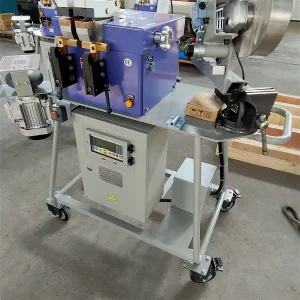
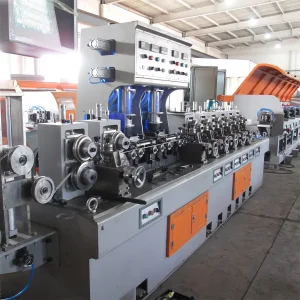
The cleaned steel strip is formed into a U-shape by our Steel Strip Forming Machine. The prepared flux powder mix is dosed into the U-channel in a continuous, high-speed operation. The seam is then closed (overlap or butt seam configuration).
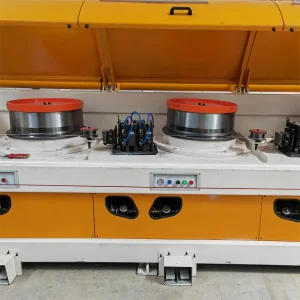
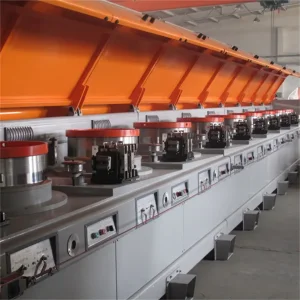
The filled wire is drawn through a series of reduction passes on our CE Certified Straight Type Drawing Machine. Heavy reductions are achieved without breaking the wire or losing fill uniformity, utilizing premium rolling cassettes and tungsten carbide drawing dies.
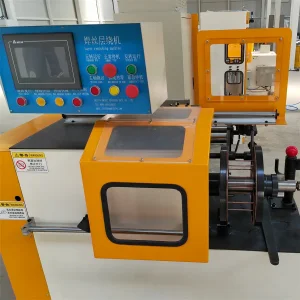
The final wire is transferred via Layer Rewinding Machines onto precise commercial spools or packaged into heavy drums using the Drum Packaging Machine, preparing the product for shipment to global end-users.
Empirical proof of our reliability and technical competence across global manufacturing hubs.
We maintain close cooperative partnerships with leading mechanical and metallurgical engineering groups in Western Europe and the Americas. This ensures our machines meet rigorous safety and efficiency standards globally.
The technological advancements that are shaping the next generation of welding wire manufacturing.
Integrating real-time laser measurement devices inside the forming machine to continuously check the fill factor. If flux density varies, the system automatically regulates the dosing screw speed to maintain consistent properties throughout the wire length.
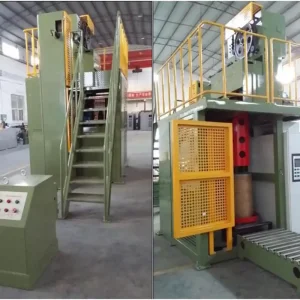
Moving from manual raw material feeding to pneumatic transfer pipelines. Sealed vacuum transport systems transfer raw components from silos to mixers, dryers, and dosing units without exposing operators to process dust or environmental moisture.
The market share of nickel-base, wear-resistant, and high-strength low-alloy (HSLA) flux-cored wires is growing rapidly. Our machines are designed to process abrasive, high-hardness metallic powders with minimal component wear.
Direct answers regarding costs, delivery times, technical specifications, and post-installation support.
Reliable, CE-compliant machinery designed for processing high-strength steel strips and drawing precision welding wire.
 Orient PengSheng