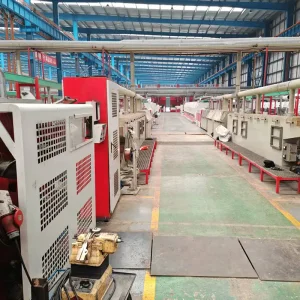
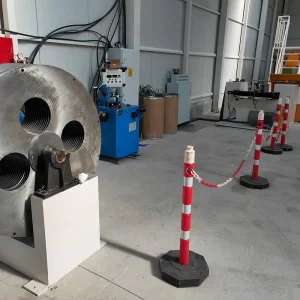
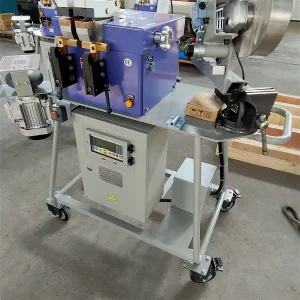
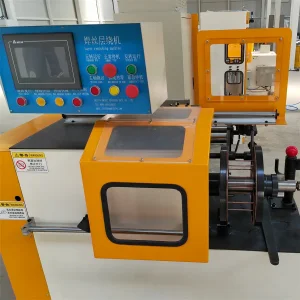
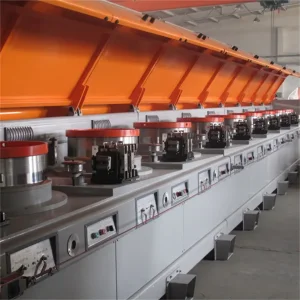
Explore our core engineering hardware designed for seamless low-carbon strip processing, chemical core filling, and precise wire-drawing.
In modern industrial fabrication, unalloyed steel flux cored welding wires (FCWs) have become the cornerstone of high-efficiency structural applications. Used extensively across heavy machinery, shipbuilding, infrastructure developments, and marine environments, these consumables bridge the gap between high deposition rates and superior mechanical performance. Unlike solid wires, flux cored wires house formulated chemical powders inside a tubular sheath, providing custom slag structures, alloy control, and dynamic shielding parameters.
As a global leader in high-capacity equipment lines, Beijing Orient Pengsheng Tech Co., Ltd. has spent over two decades developing the foundational machines that manufacture these vital consumables. From low-carbon steel strip slitting, ultrasonic strip cleaning, roll forming with butt seam or overlap setups, straight-line drawing with rolling cassettes, through to high-speed winding and packaging, our technical portfolio ensures low hydrogen levels, high physical consistency, and exceptional feedability for end-users.
The transition from manual stick welding and standard solid wires (GMAW) to flux-cored arc welding (FCAW) has accelerated worldwide. Industries are faced with rising labor costs and the continuous demand for increased throughput. The unalloyed steel category—predominantly dominated by classifications such as AWS A5.20 E71T-1C / E71T-1M—remains the highest volume product sector in the industry. These wires provide outstanding out-of-position weldability, fast-freezing slag structures, and minimal spatter when paired with CO2 or Argon/CO2 gas mixtures.
Factories manufacturing these consumables must maintain absolute structural precision. Variations in strip dimensions, uneven core fill ratios, or residual drawing lubricants on the finished wire surface can result in weld defects, wire slippage, and increased hydrogen-induced cracking risks. Beijing Orient Pengsheng Tech Co., Ltd. addresses these challenges by supplying integrated, high-precision turnkey manufacturing plants designed to comply with rigorous CE certification and international quality baselines.
Established in 2011, Beijing Orient Pengsheng Tech. Co., Ltd. brings together more than 20 years of operational experience with specialized flux cored welding wire manufacturing lines. With direct technical support from our European cooperators combined with our internal continuous R&D, we have successfully developed proprietary technology and proprietary manufacturing methodologies in this heavy industry.
We dedicate ourselves to supplying flux cored welding wire production equipment featuring the latest technical innovations and robust reliability. By combining advanced control hardware with heavy-duty mechanics, our manufacturing systems produce wires that exceed standard criteria for high-precision robotic and automated applications globally.
Our systems are engineered to streamline operational expenditures, increase raw material efficiency, and secure flawless reliability.
We implement European design paradigms. Critical machining components and proprietary forming assemblies are imported directly from Europe to assure micrometric tolerance control.
With hundreds of production lines running worldwide, our equipment handles massive operations under extreme conditions, producing highly uniform flux-cored wires day in, day out.
Our dedicated engineering department is staffed by specialists with solid metallurgical backgrounds, providing pre-sales layout design, system installation, and lifecycle maintenance.
We work closely with clients to gather feedback and continually refine our systems. We configure custom manufacturing profiles based on regional wire grades and steel strip sourcing options.
Producing flux cored welding wires is a multi-step manufacturing sequence requiring high mechanical precision and tension management to protect the integrity of the inner powder fill.
| Process Stage | Primary Machinery Involved | Critical Control Parameters | Quality Objective |
|---|---|---|---|
| 1. Slitting & Preparation | Low carbon steel strip slitting machine | Strip width tolerances within ±0.05 mm, burr height | Uniform strip width for consistent forming |
| 2. Cleaning | Ultrasonic steel strip cleaning machine | Chemical concentration, bath temp, ultrasonic frequency | Removal of surface oxides & lubricants (Low Hydrogen) |
| 3. Powder Prep | Flux powder mixing machine & dryer | Moisture content, mesh grain size, blend uniformity | Consistent chemical formulation in the core |
| 4. Forming & Filling | Steel strip forming machine (Butt & Overlap) | Forming profile, strip tension, continuous powder feed rate | Target fill ratio (usually 15-20%) with zero gaps |
| 5. Drawing & Cassettes | Straight type drawing machine / rolling cassettes | Area reduction ratio per block, cooling efficiency | High tensile strength, target wire diameter, smooth surface |
| 6. Winding & Packaging | High precision layer rewinder / Drum packager | Spooling tension, line speed matching, layer alignment | Cast and helix parameters for robotic welding feeds |
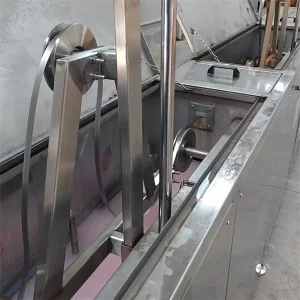
Hydrogen is the primary cause of cold cracking in carbon-manganese steel weldments. Our inline ultrasonic cleaning systems effectively strip all lubricants, oil film residues, and surface impurities from the raw steel strips before forming. Implementing ultrasonic cavitation along with specialized aqueous cleaning media ensures a completely clean metallic channel to house the flux powders, securing low diffusible hydrogen performance (<4ml/100g of weld metal).
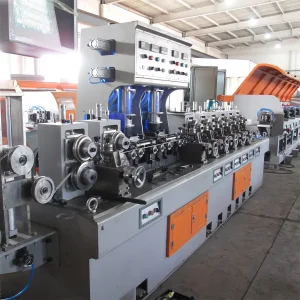
The configuration of the seam is a crucial parameter in FCW manufacturing. Beijing Orient Pengsheng Tech Co., Ltd. offers advanced forming systems utilizing both overlap structures (best for seamless protection of internal powder in general applications) and precise butt seam interfaces. Precision-hardened forming rollers fold the strip into a U-shape, introducing the mixed powder continuously from a high-accuracy powder hopper before locking the seam shut through consecutive finishing roller passes.
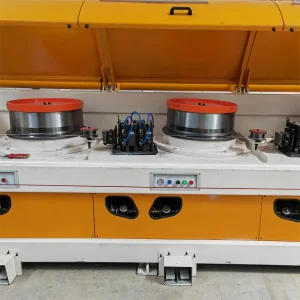
To reduce the wire from the formed outer diameter down to the final diameter (typically 1.2 mm, 1.4 mm, or 1.6 mm), standard dies can create excessive friction and surface defects. Our systems utilize rolling cassettes combined with straight-line wire drawing machines. These cassettes compress the wire from multiple axes, replacing sliding friction with rolling deformation. This extends die life, minimizes energy consumption, and reduces the need for heavy external lubrication, resulting in clean, defect-free welding consumables.
The manufacturing landscape for unalloyed steel flux-cored welding wires is entering a transformation driven by automation, digital quality control, and eco-friendly practices. Below are the key technological advancements shaping the next generation of wire manufacturing lines:
Whether for shipbuilding in South Korea and Northern Europe, bridge construction in the United States, or heavy industrial machinery manufacturing in developing markets, unalloyed steel flux cored wires must meet varied climatic and operational standards. For offshore marine sectors, low-temperature impact toughness is paramount. This requires lines to run precise flux powder formulations that optimize nickel and manganese values in the weld pool. Beijing Orient Pengsheng Tech Co., Ltd. provides customized line configurations to ensure clients can produce specialized wire chemistries (such as E71T-9C / E71T-12M) that meet classification society rules (ABS, DNV, LR, etc.).
Detailed technical and commercial answers directly from our engineering and sales departments.
Complementary equipment to complete your manufacturing facility, ensuring continuous operation and precision control.
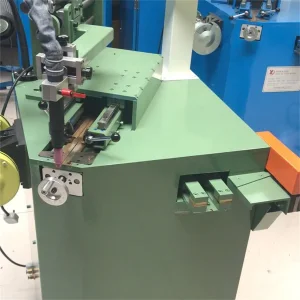
To design an efficient flux-cored welding wire production plant, it is necessary to examine each functional subsystem. Below, our engineering team breaks down the design elements that define a high-yield production line.
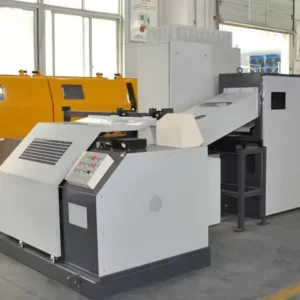
Before forming, wide steel coils must be divided into narrow strips matching the design perimeter of the target wire diameter. Our slitting line slits the parent steel coil into up to 15 precision strips. Constant hydraulic back-tension control avoids edge deformation and camber defects, ensuring uniform forming mill performance.
Friction residues and rust-preventative oils from cold-rolling are removed in our high-power ultrasonic baths. The equipment combines hot alkaline washing, high-frequency ultrasonic exposure, clean water rinsing, and high-velocity hot air drying. Clean steel surfaces are critical to maintaining low-hydrogen parameters and preventing porosity defects in the finished weld.
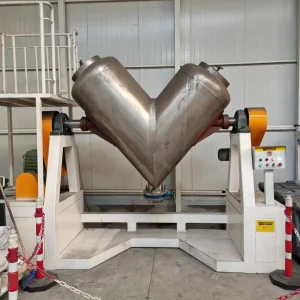
The powder mix determines the final welding performance. Our system utilizes a dual-axis paddle mixer to distribute mineral components, iron powders, and deoxidizers uniformly. Controlled drying cycles reduce residual moisture to minimize hydrogen pickup. Our continuous powder feeding system uses weight sensors to feed the mix into the forming mill with minimal variation.
Our forming system folds the clean steel strip into a tubular profile. The line is designed for quick tooling changes, allowing operators to switch between butt seam configurations (which require tight seams to prevent powder leakage during drawing) and overlap seam profiles. The powder is fed into the strip channel immediately prior to closing, ensuring a consistent fill ratio.
After forming, the filled tube is drawn to its final diameter. Our straight-line drawing machines feature dynamic tension sensor arms and water-cooled blocks. We use rolling cassettes in the initial drawing passes to reduce drawing stress, which minimizes strip breakage and reduces the need for lubricants, leaving the wire surface clean.
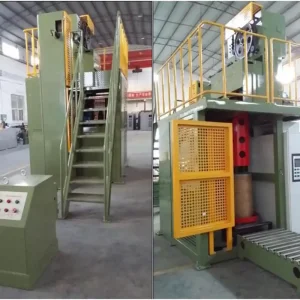
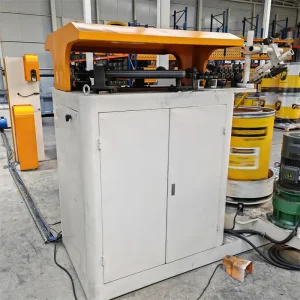
The final step is winding the wire onto spools or into fiber drums. Our layer rewinding machines use closed-loop control to lay the wire in precise rows. This avoids overlapping, crossovers, or inconsistent tension, ensuring smooth feeding in high-speed robotic welding cells.
Beijing Orient Pengsheng Tech Co., Ltd. has delivered complete manufacturing solutions to clients in Europe, the Americas, and Asia. Our service team manages on-site commissioning and works with clients to optimize their processes for local raw materials, helping them achieve optimal production efficiency.
 Orient PengSheng