Explore our core engineering systems designed for complete flux-cored and solid welding wire production processes, certified for international performance standards.
Forging Excellence in Flux-Cored Wire Machinery Since 2011
Established in 2011, Beijing Orient Pengsheng Tech. Co., Ltd. has developed deep technical roots, leveraging over 20 years of research and manufacturing experience specializing in high-end flux-cored welding wire (FCW) production equipment. Supported by premium European technical partnerships, we have established our own proprietary engineering know-how, state-of-the-art manufacturing facilities, and highly rigorous quality management systems.
Our company focuses on bridging the gap between sophisticated metallurgy and modern automation. By offering equipment that meets and exceeds strict CE compliance standards, we help industrial manufacturing clients worldwide build highly efficient, stable production loops for both hardfacing alloys and general structural steel welding consumables.
A technical assessment of heavy industrial surface engineering, metallurgical optimization, and compliance requirements in modern manufacturing plants.
Hardfacing requires high deposition rates and consistent alloy chemistry. Our equipment produces flux-cored wires designed for high-abrasion, impact, and high-temperature environments. Whether fabricating Chromium Carbide Alloys (CCO) or complex martensitic matrices, consistent powder-fill density is maintained via precise servo controls.
European safety regulations (Machinery Directive 2006/42/EC, Low Voltage Directive 2014/35/EU) demand rigorous risk mitigation. Every wire drawing and strip forming machine we produce integrates electrical interlocks, noise reduction shrouding, and dual-channel safety relays to secure CE verification.
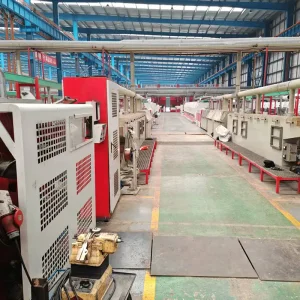
Industrial operations in North America, Western Europe, and Southeast Asia look for turnkey systems that minimize downtime. Beijing Orient Pengsheng provides integrated process control—from raw strip slitting to heavy-duty drum packaging—facilitating immediate startup.
The manufacturing of high-performance hardfacing welding wire is a multi-stage process where tolerances determine the final product quality. An uneven distribution of flux powders (containing ferroalloys, carbon, chromium, molybdenum, or manganese) within the steel sheath causes variations in deposit hardness during welding, causing weld failures or spatter.
To prevent these issues, our production lines utilize high-precision CNC slitting and steel strip forming systems. By utilizing either *overlap* or *butt-seam* geometric profiles, the forming line ensures that the dry flux core is encapsulated tightly. An advanced continuous monitoring system controls powder feeding weights in real-time, matching strip speed dynamically.
Following strip forming, the wire passes through a sequence of straight-line drawing stages utilizing tungsten carbide dies and rolling cassettes. This gradual reduction of cross-sectional area ensures the steel sheath work-hardens evenly, preserving ductile characteristics while reaching high final tensile strength values required for high-speed automatic feed systems.
Why Tier-1 industrial welding wire manufacturers choose Beijing Orient Pengsheng machinery solutions for high-performance plant operations.
We deploy advanced fabrication tools, and select core electronic, hydraulic, and mechanical components sourced directly from leading European suppliers. This guarantees high precision and minimizes long-term component wear.
Hundreds of our systems operate globally in demanding plant conditions. We continuously test our designs under real manufacturing conditions to ensure our forming and drawing systems deliver long-term reliability.
Our dedicated engineering service department employs qualified technicians with deep industry backgrounds. From initial engineering drawings and installation to operator training and ongoing spare parts supply, we offer end-to-end project execution.
We tailor machine setups to match your production constraints. Our engineers analyze user feedback to modify control software, roll designs, and payout configurations, optimizing operations for individual mill requirements.
Understanding the sequential mechanical stages required to transform hot-rolled coils into premium, high-density flux-cored wires.
Divide wide low-carbon steel strip coils into precise narrow bands matching targeted wire diameters.
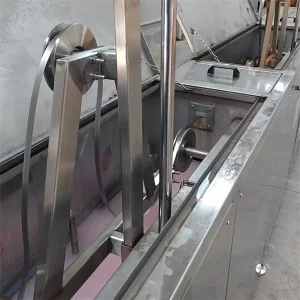
Remove drawing lubricants, rust, and oils using multi-stage ultrasonic baths for high-purity metal surfaces.
Roll form the steel strip into a U-shape, meter the flux powder composition, and close the profile tightly.
Reduce wire diameter through straight-line capstans, and spool the finished product using precision winding machines.
A closer look at the functions of our main processing systems designed for industrial flux-cored welding wire production.
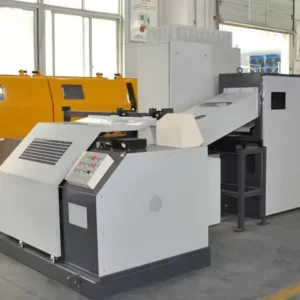
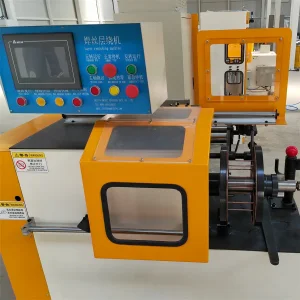
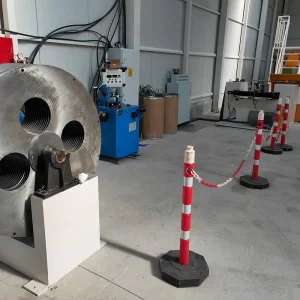
Designed to process wide base metal coils into narrow strips (max. 15 pieces simultaneously). This system features a high-rigidity cutter arbor, precise spacer setup, and loop tension controls to ensure clean edges and minimal burrs.
To produce high-quality flux-cored wire, the steel strip surface must be completely free of organic contaminants and rust. Our system combines ultrasonic cavitation with hot alkaline washing and dry hot-air blowers to ensure a clean surface.
This system supports both overlap and butt-seam configurations. It bends the clean steel strip into a precise U-shape profile to receive the dry flux core, then securely closes the tube before drawing.
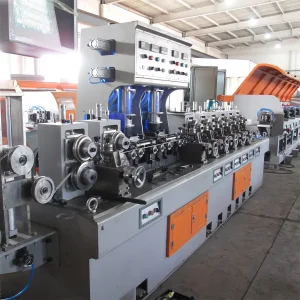
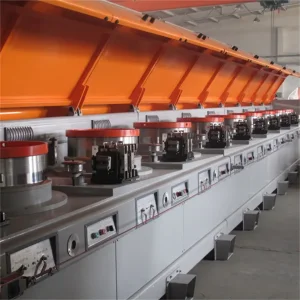
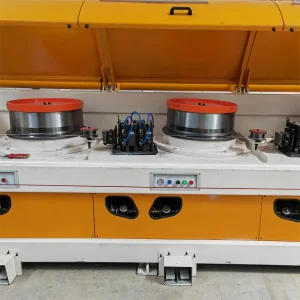
Using advanced AC variable frequency drive controls and direct-drive pulleys, our straight-type drawing systems reduce the filled wire diameter to final gauge tolerances without twisting or damaging the internal core.
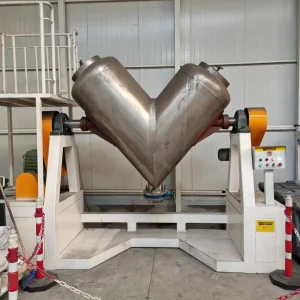
Ensures uniform distribution of alloy components. The dry mixer operates with controlled rotation speeds to prevent powder segregation, while the mesh vibrator controls particle size distribution.
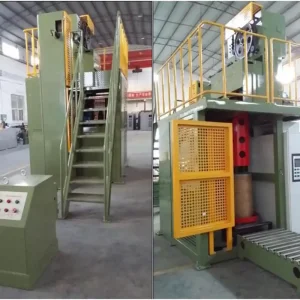
Designed for high-speed automated packaging of finished wire. It features precise layout control to pack wire coils into drums or pails with consistent tension, avoiding twists during payoff in robotic welding stations.
At Beijing Orient Pengsheng, we are focusing on integrating digital twin technology and IoT connectivity into our manufacturing platforms. Industry 4.0 demands that machines operate as part of a connected network rather than in isolation.
By integrating sensors throughout our drawing dies, forming rollers, and powder feeding units, we collect operational data on power consumption, strip tension, tool wear, and speed variations. These metrics allow operators to predict tool maintenance needs and adjust machine settings dynamically.
Our R&D efforts are also directed at improving energy efficiency. We are optimizing our motor drives and drawing geometries to reduce energy consumption per ton of wire produced.
Technical answers to common questions about our equipment, manufacturing processes, and compliance standards.
Contact Beijing Orient PengSheng Tech. Co., Ltd for customized configurations, detailed machinery specifications, and official quotations.
Send Engineering InquiryExplore more high-precision equipment configurations and auxiliary modules designed for various manufacturing scales and alloy formulations.
 Orient PengSheng